Foundations first: why your AI pilots aren’t paying back
By
EX3
08 October 2026
08 October 2026
•
5 min read
Share this insight
Cloud Payroll Demystified: Separating Fact from Fiction
For global organizations, payroll is far more than a transactional process. It’s a critical pillar of employee trust, financial control, and compliance assurance. But for many businesses still reliant on legacy payroll systems, the landscape is riddled within efficiencies, fragmentation, and risk. As workforce demands evolve and technology accelerates, many HR and finance leaders are asking: Is it time to move payroll to the cloud?
At EX3, we’ve guided enterprise clients through that very question — and the answer is increasingly a resounding yes. But as with any transformation, myths and uncertainties can cloud the journey. That’s why we’re here to separate fact from fiction and show how cloud payroll, especially through SAP, is not only viable but transformative.
"Clients are often surprised by how quickly the myths about cloud payroll fall apart once they see a well-executed transformation. At EX3, we combine deep SAP expertise with a clear methodology that makes change not only manageable but advantageous. The cloud isn’t just about technology — it’s about unlocking a new level of operational intelligence, agility, and employee trust."
— Jas Rai, Managing Partner, EX3
The Business Case for Payroll Transformation
Legacy payroll systems are often stitched together through custom code, spreadsheets, and siloed teams. They may “work,” but at a cost: increased operational risk, slow adaptation to regulatorychanges, and an inability to scale across regions. Cloud payroll, powered by SAP, offers a chance to modernize these operations into a cohesive, secure, and future-ready function.
74%
74% of CFOs say outdated systems are a major barrier to payroll accuracy and compliance in multinational organizations.
35%
Organizations using cloud payroll report up to 35% reduction in payroll processing time and significant improvement in compliance audit readiness.
These numbers make the case clear: transforming payroll is not just about technology — it's about enabling agility, resilience, and global growth.
Benefits of Cloud Payroll with SAP & EX3
When clients move to a modern payroll solutionpowered by SAP SuccessFactors and SAP Payroll, they gain measurable,strategic benefits. Through our implementations, EX3 clients typically realize:
Global standardization: Unified processes and controls across all countries and legal entities
Improved compliance: Real-time updates on local tax laws and labor regulation
Enhanced employee experience: Self-service access to pay statements and tax forms
Real-time insights: Dashboards and analytics for payroll cost visibility and forecasting
Reduced operational overhead: Automation and exception-based processing
Scalability: Easily onboard new business units or regions without replatforming
Future-readiness: Native AI and machine learning integration for predictive insights
SAP’s Vision for the Future of Payroll
SAP has long led the enterprise payroll space,but the shift to the cloud is more than a re-platforming — it’s a reinvention.
“Payroll is now a strategicdriver of workforce agility. With AI capabilities embedded into SAP's cloudpayroll, we’re helping clients predict issues before they happen, optimizelabor costs, and ensure regulatory alignment in real time. It’s not just smarterpayroll — it’s smarter business.”
— Jane Doe, Global Executive, SAP
This future-facing approach meansorganizations can move beyond reactive payroll operations to proactiveworkforce planning, all while ensuring accuracy, compliance, and employeesatisfaction.
AI + Payroll: More Than Just Automation
One of the most exciting developments in SAP’scloud payroll roadmap is the integration of AI and machine learning intocore processes. These technologies offer advanced capabilities like:
Predictive anomaly detection: Flagging potential payroll errors before payment
Regulatory change monitoring: Automated alerts and adjustments for global compliance
Natural language interactions: Conversational interfaces for employees and payroll teams
Payroll cost optimization: AI-driven recommendations for managing overtime and labor spend
By leveraging AI, companies move from static processing to intelligent, learning systems — making payroll a proactive tool rather than a reactive cost center.
Considerations Before You Start
Cloud payroll transformation is a majorinitiative — but with the right planning, it can be both successful andstrategic. Before starting, organizations must assess their readiness acrossseveral areas. First, HR and payroll teams should be aligned on goals,timelines, and expectations. Data integrity is also crucial; existing payrolldata must be clean, complete, and well-structured to ensure a smooth migration.
System integration is another key consideration — especially if payroll needsto connect with time tracking, benefits, or finance platforms. Companies shouldalso ensure they have clear visibility into compliance requirements across alljurisdictions where they operate. Finally, change management is essential.Organizations must prepare their employees and managers for new processes,tools, and expectations to ensure widespread adoption and success.
EX3 provides frameworks and checklists toensure each of these areas is addressed before a single line of code iswritten.
How EX3 Supports End-to-End Payroll Transformation
Payroll transformation is not a lift-and-shiftexercise. It requires a partner who understands both the technology and thepeople side of change. That’s where EX3 stands out.
Our HR & Payroll transformationservices include
Strategic advisory: Business case development, readiness assessments, and roadmap planning
End-to-end SAP Payroll implementation: From global blueprinting to go-live and hypercare
AI enablement: Embedding intelligent features in SAP Payroll for maximum ROI
Change management: Ensuring adoption across HR, finance, and the broader enterprise
Ongoing optimization: Continuous improvement and compliance updates post-implementation
With deep experience in complex global payrollenvironments, our team brings a pragmatic, collaborative approach thataccelerates value realization and de-risks the journey.
Let’s Build the Payroll of the Future — Together
At EX3, we believe payroll is a strategicasset. When executed well, it builds trust, enables scale, and deliversinsights that shape the workforce of tomorrow.
If you're ready to explore how cloud payroll —powered by SAP and implemented by EX3 — can drive transformationin your organization, we're here to help.
Contact us today toschedule a discovery session with one of our HR transformation specialists.
Jas Rai
Founder & Managing Partner
Jas has over a decade of experience in HR Technology, combining deep business and technical expertise. Jas oversees the Finance, Operations, Sales, and Client Engagement functions atEX3, ensuring cohesive and effective management across the business.
Stay Updated with Our Insights
Lorem ipsum dolor sit amet, consectetur adipiscing elit.
Nobody at the Gartner HR Symposium in London is short of AI use cases. Most HR leaders can list a dozen pilots, and most can’t point to the return.
The numbers explain why. Gartner research from October 2025 found that 88% of HR leaders say their organisation hasn’t realised significant business value from AI tools. Gartner’s April 2026 findings put the share of AI use cases that fully succeed and meet ROI expectations at 28%, with skills gaps and poor data leading the causes. MIT NANDA’s 2025 research found that 95% of enterprise generative-AI pilots delivered no measurable P&L impact.
Piloting AI was never the hard part. Proving the return is.
An ROI problem is a foundations problem
On the EX3 stage, Iain Kirkwood (Chief Human Resources Officer) and Harriet Ashelby (Head of Advisory) argued that the market doesn’t have a use-case problem. It has an ROI problem, and an ROI problem is a foundations problem. Use cases don’t fail on their own merits. They fail because the organisation underneath them isn’t ready to support them.
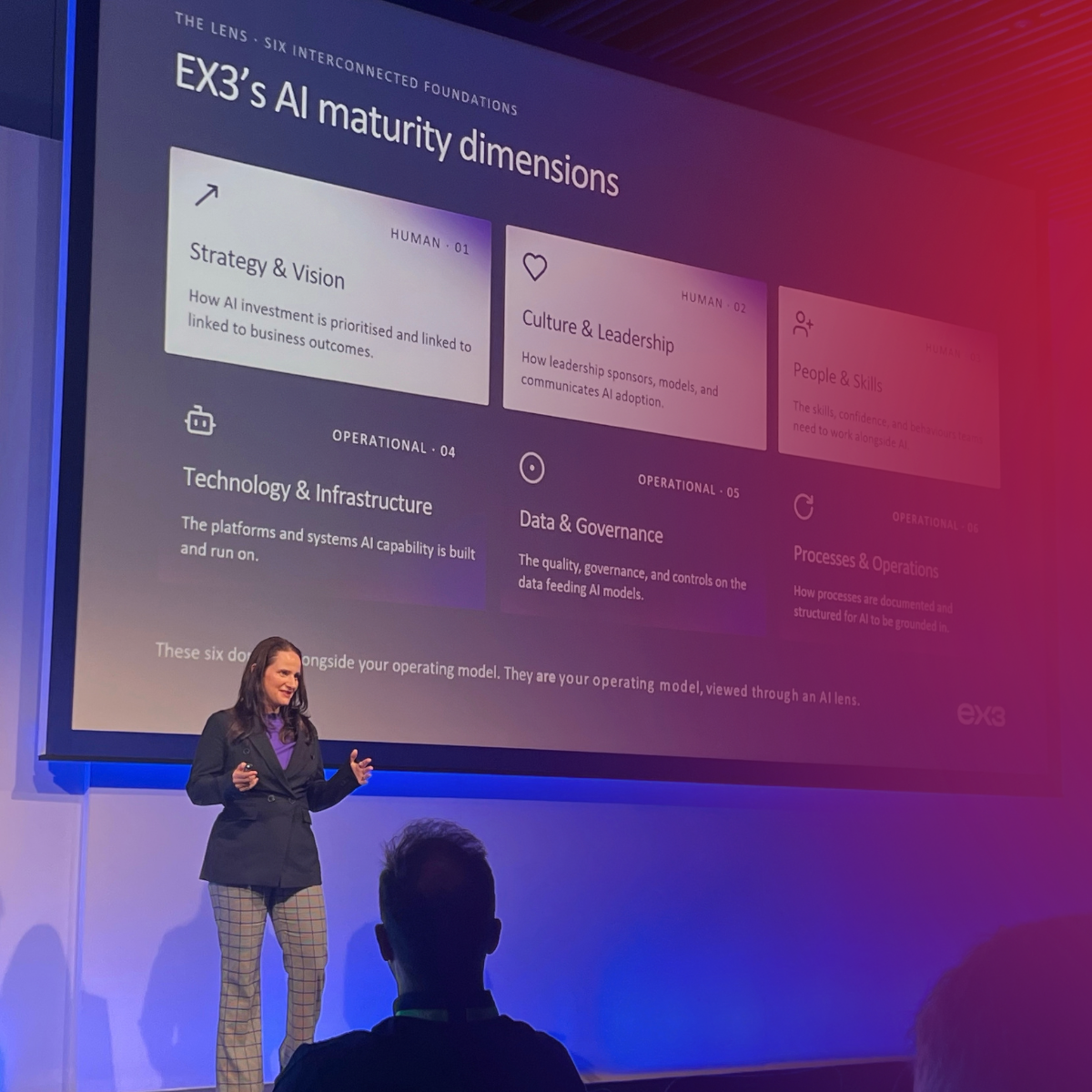
EX3 frames readiness as six interconnected foundations, split evenly between the human and the operational:
Human foundations cover how people think, lead and behave: Strategy & Vision, Culture & Leadership, and People & Skills.
Operational foundations cover how the organisation actually runs: Technology & Infrastructure, Data & Governance, and Processes & Operations.
Iain and Harriet were clear that these six don’t sit alongside your operating model. They are your operating model, viewed through an AI lens. Each is scored on a five-level scale: Unaware, Exploring, Developing, Integrating, Leading.
We scored ourselves first
Rather than present a client case study, EX3 put its own scorecard on screen. Eighteen months ago, the picture was front-end ambition with a back-end gap. There was genuine energy for AI and a solid technology base, but the strategy, documentation and data groundwork hadn’t caught up.
Leadership, culture and skills led the turnaround, with the data and process foundations catching up behind them. It was achieved with no big capital spend. The biggest gains came from the human foundations, not new technology.
Then the room scored itself
Attendees scored their own organisations from 1 to 5 on each of the six foundations, live and anonymously, using the same scale. The rules were simple: gut instinct is fine, and score where you are, not where you plan to be. Results were shown back to the room on the spot.
Key Takeaways
AI is a people transformation, not just an IT one. Adapt, don't just adopt.
Most organisations are still at an emerging stage of AI maturity.
Embed your AI strategy into your people strategy to see real ROI.
Start with the foundations. Before you launch another pilot, find out which of the six is holding you back. The answer is rarely the technology.
Take the assessment
You don’t need to have been in the room. The same six-question assessment takes about two minutes, and your answers are anonymous. It will show you where your organisation stands on each foundation, and where to focus first.


%20copy%202.jpeg)
